
If you are on your feet for eight or nine hours, the shoe that felt fine when you put it on is not the shoe you are wearing by the end of the shift. Feet spread and swell through the day. Hard floors give nothing back. The shoe stays exactly the same size.
That mismatch is what causes most end-of-day foot pain at work — not the standing itself.
What a long day on hard floors actually does
Standing still is harder on feet than walking. Walking changes which part of the foot is loaded from step to step; standing keeps the pressure in one place. Add a tiled or concrete floor and a thin sole, and the same few square centimetres take the load all day.
By mid-afternoon most people’s feet have gone up noticeably in girth. If the shoe has no way of opening up — no laces, no strap, no give in the upper — that extra volume has nowhere to go, and it presses on whichever part of the foot is least able to take it.
The five things that matter
1. Depth, not just width
Extra depth gives toes room to sit rather than being pressed down by the upper. It is also what lets you fit an insole of your own without losing space.
2. A fastening you can adjust
Laces or a touch-fastening strap let you slacken the shoe off as the day goes on. A slip-on that fits at 8am has no way of adapting by 4pm.
3. A seam-free interior
An internal seam you cannot feel on the first morning is the one that rubs by the end of the week. This matters most if you have reduced sensation in your feet.
4. A sole that cushions and rolls
A cushioned midsole takes the sting out of a hard floor. A rocker profile helps the foot roll through each step, which is useful when the joints at the ball of the foot are stiff.
5. Grip you can trust
Kitchens, wards and shop floors get wet. A slip-resistant outsole is not an optional extra.
Which style suits which job
Lace-ups — for a full shift in one place
The most adjustable option, and the most secure on the foot. If you are standing all day rather than walking miles, this is usually the right starting point. See orthopaedic shoes for women and orthopaedic shoes for men.
Touch-fastening styles — for feet that change size through the day
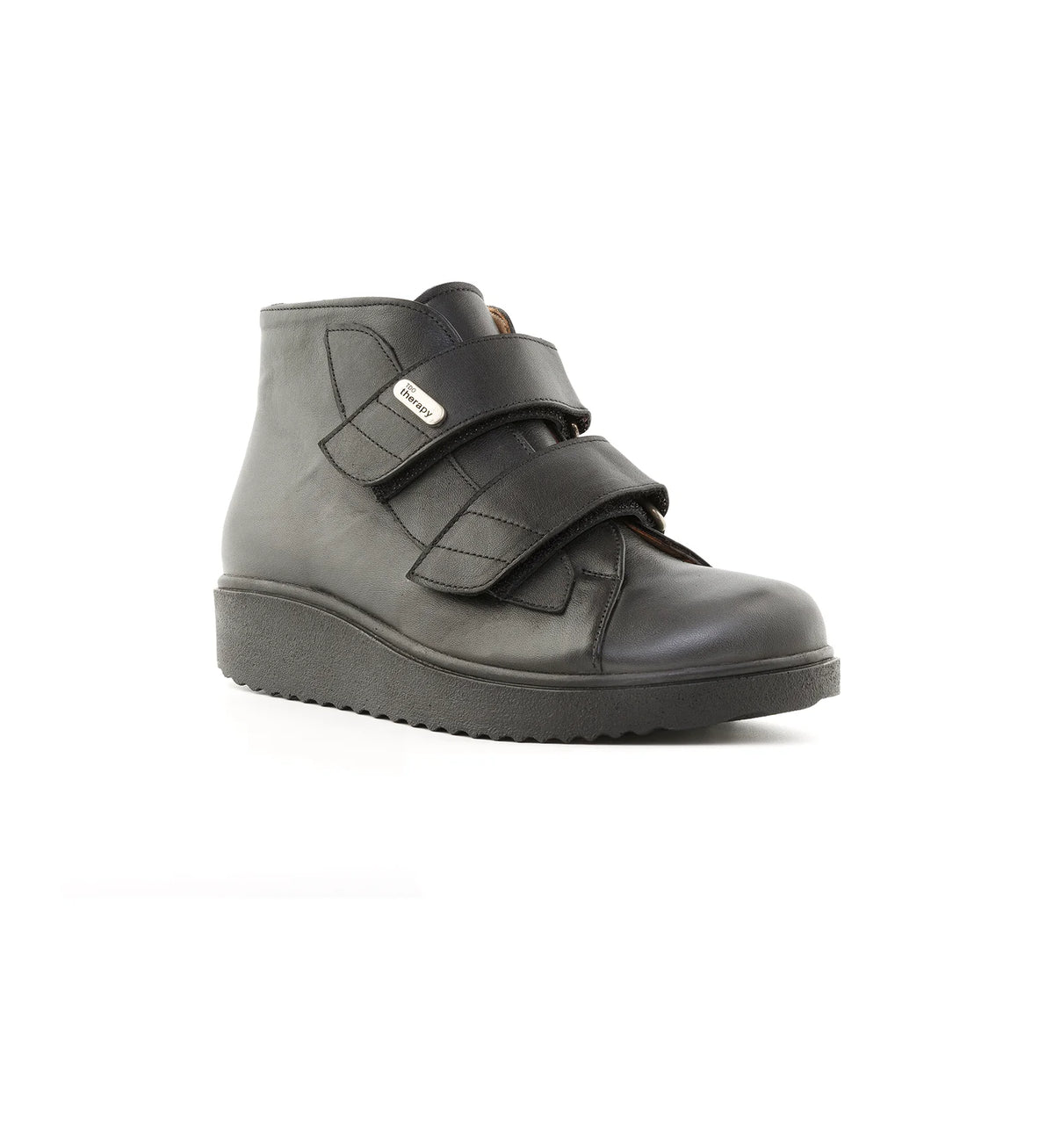
A strap can be opened one-handed, without bending down, and re-set in seconds once your feet have spread. Worth looking at if you finish the day with marks across the top of your foot: shoes for swollen feet.
Extra-depth styles — if you wear a prescribed insole
Your orthotic only does its job if the shoe has the depth to take it and still leave room over the toes. Shoes for orthotics have a removable factory insole for exactly this reason.
Need more width than a standard shoe gives? Our fittings run EE, EEE, 4E and 6E — see wide fit shoes for women and wide fit shoes for men.
Getting the fit right
- Try shoes on late in the day, when your feet are closest to how they will be at work.
- Wear your work socks. A thick sock can take up a whole width fitting.
- Leave a thumb’s width at the end of the longest toe — which is not always the big toe.
- Check the depth by feel. Press gently across the top of the shoe; you should not feel it resting on your toes.
- Break them in on a short day first, not on a twelve-hour shift.
- Keep two pairs and alternate them. Cushioning recovers overnight, and a shoe worn every single day flattens faster.
We have made our footwear in our own factory since 2005. If you would rather be measured properly, our fitting room is at 49 Downing Street, Farnham, Surrey GU9 7PH, open Monday to Saturday 10:00–17:00 — book a fitting or call 01428 751602.
Frequently asked questions
How often should work shoes be replaced?
For a full-time job on your feet, six to twelve months is realistic. The signs are a flattened insole, tread worn away on one side, and a heel that no longer holds its shape.
Are trainers good enough for standing all day?
Some are. The usual problem is depth. A running shoe is built for a foot in motion, not for a foot that has gained a width fitting’s worth of volume by 4pm.
My feet only hurt at the end of the shift. Is that normal?
It is common, but it is worth acting on. Pain that arrives late in the day is usually a fit problem rather than a shoe-quality problem — the shoe stopped fitting hours before it started hurting.
Can I wear my own insoles in them?
Yes, in any style with a removable insole. Take the factory insole out first so you keep the depth over your toes.